How to choose stable management software
Most comparisons of yard software list features. Features are the easy part — nearly everything on the market records a horse and a vet visit. What separates one system from another is how it charges, who it lets in, what happens to your data and whether it survives contact with a busy Tuesday. Here is what to ask, including where the honest answer is that you do not need software at all.
In short
- Check how it charges: per user pricing quietly punishes you for giving owners access.
- Ask whether features are held back for a bigger plan — the one you need is usually one tier up.
- Find out who can get a login, and whether that costs extra.
- Ask where the data is hosted and whether it is used to train AI models.
- If you keep two horses and no clients, a spreadsheet may genuinely be the right answer.
Start with the pricing model, not the price
Two systems at the same monthly figure can behave completely differently as you grow. Per-user pricing means every owner you give access to costs you money, so you end up rationing logins — which defeats the reason for having them. Per-feature tiers mean the thing you actually came for sits one plan above the one you priced. Ask what the number does when you add a horse, an instructor, and twenty owners, and compare those three answers rather than the headline.
Ask who gets a login
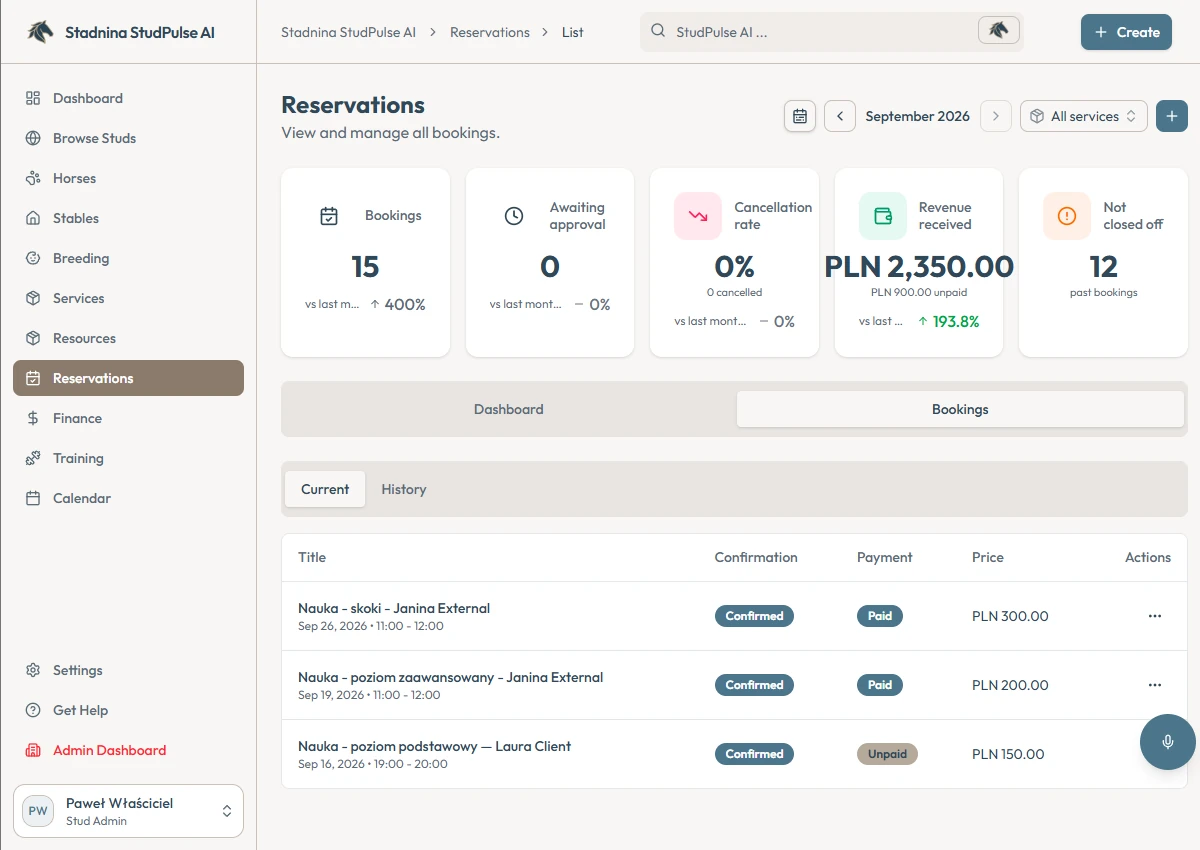
A yard is not just its staff. Horse owners want to see their own horse and what they owe; riders want their bookings; a vet wants the history without a phone call. If giving those people access is expensive or impossible, every question they have comes back to you by phone. Find out whether client and owner access exists, what it costs, and whether they see only their own horse — the last part matters as much as the first.
Ask where the data lives and what is done with it
Two specific questions, both of which have a right answer and a wrong one. Where is it hosted — and if you are in the EU, does that matter to you legally? And: is it used to train AI models? Any system with an AI feature sends your records to a model provider, and whether that provider retains them is a decision the vendor made on your behalf. It should be written down, not explained on a call.
Work out what it costs to leave
Ask how you get your data out, in what format, and whether it costs anything. This is the question vendors answer least enthusiastically, and the answer tells you how confident they are that you will want to stay. A system that makes export easy is one that expects to keep you by being useful.
Test it against a real week, not a demo
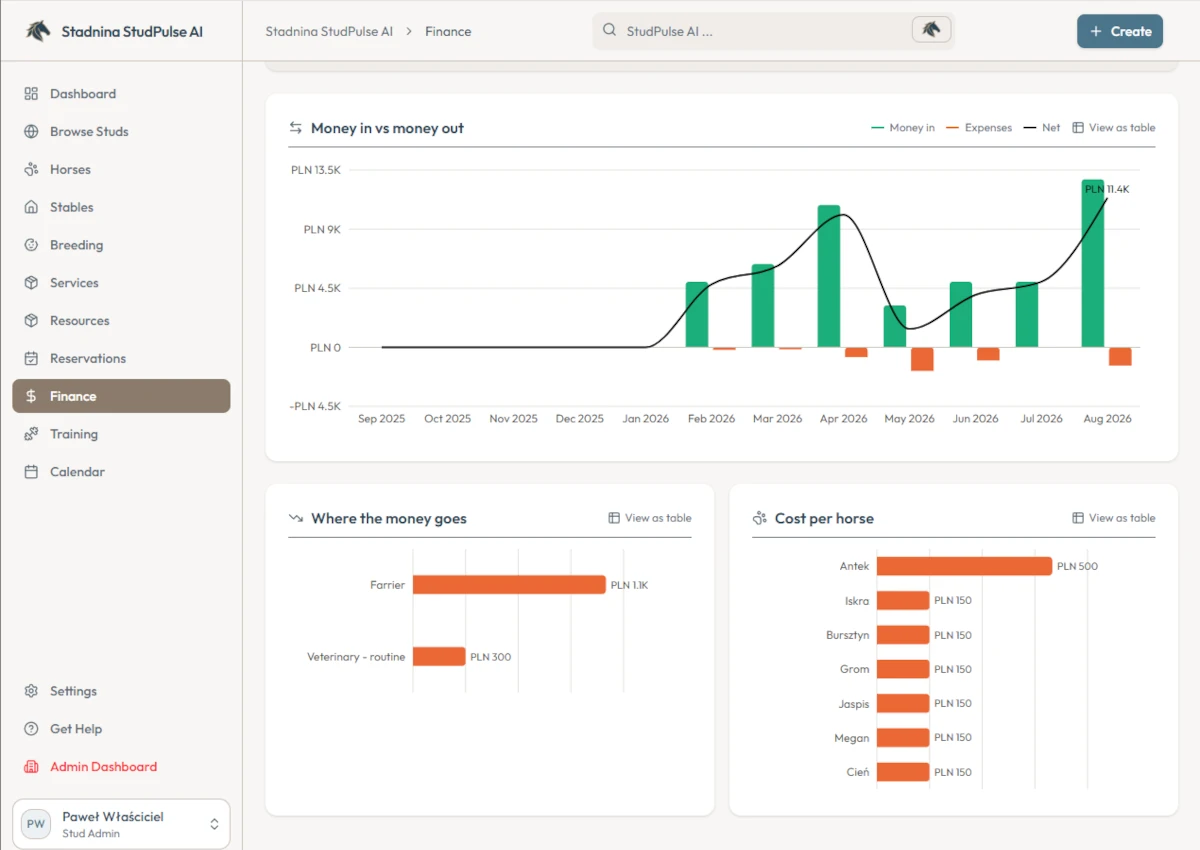
Demos are built from clean data on a quiet afternoon. Take a trial and enter one genuinely awkward week: the horse that moved boxes mid-month, the owner who pays late, the lesson somebody cancelled an hour before, the shared hay invoice covering nine horses. If the system handles those, the tidy parts were never in doubt. If it cannot, no feature list will save it.
When you should not buy software at all
If you keep one or two horses, have no clients and no staff, and nothing is billed to anybody, a notebook or a spreadsheet is genuinely fine and you should keep your money. Software earns its place when there is somebody to answer to — an owner, a client, an accountant, a partner — or when there is more happening than one person can hold in their head. Below that line, the honest answer is that it is overhead.
Where this usually lands
- One or two horses, no clients: a spreadsheet, and StudPulse is free at that size if you want it anyway.
- A working yard with owners, staff or clients: worth paying for, and the pricing model matters more than the monthly figure.
- Sixty horses and up: whatever you choose, budget for migrating what you already have — that is the real cost.
Frequently asked questions
Is per-user or per-horse pricing better?
For a yard, per-horse is usually better, because workload tracks horses and not headcount. Per-user pricing makes every additional login a cost, which discourages exactly the thing that helps most — giving owners and clients their own access instead of fielding their questions by phone.
Do I need software with an AI feature?
Only if it removes work you actually do. An AI that answers from your own records saves the time you spend assembling an answer from four screens. One that only rephrases text you already wrote is a feature to be charged for, not one to benefit from. Ask what it reads before it answers.
How long should a trial be?
Long enough to include a billing cycle and one awkward week. Thirty days is usually right; anything under a fortnight only shows you the parts that were easy. Use it on real data rather than test entries, because the difficulty is always in the exceptions.
What is the most commonly missed question?
How you get your data out. It is easy to forget when you are focused on getting started, and it is the one that determines whether the decision is reversible.
Is StudPulse always the right answer?
No. If you keep two horses, bill nobody and answer to nobody, you do not need this or anything like it. It is free at that size, so nothing stops you using it, but a notebook is not a worse tool for that job.
Test it against your own awkward week
Free for up to two horses, permanently. Thirty days free on any paid plan, and no card to get started.